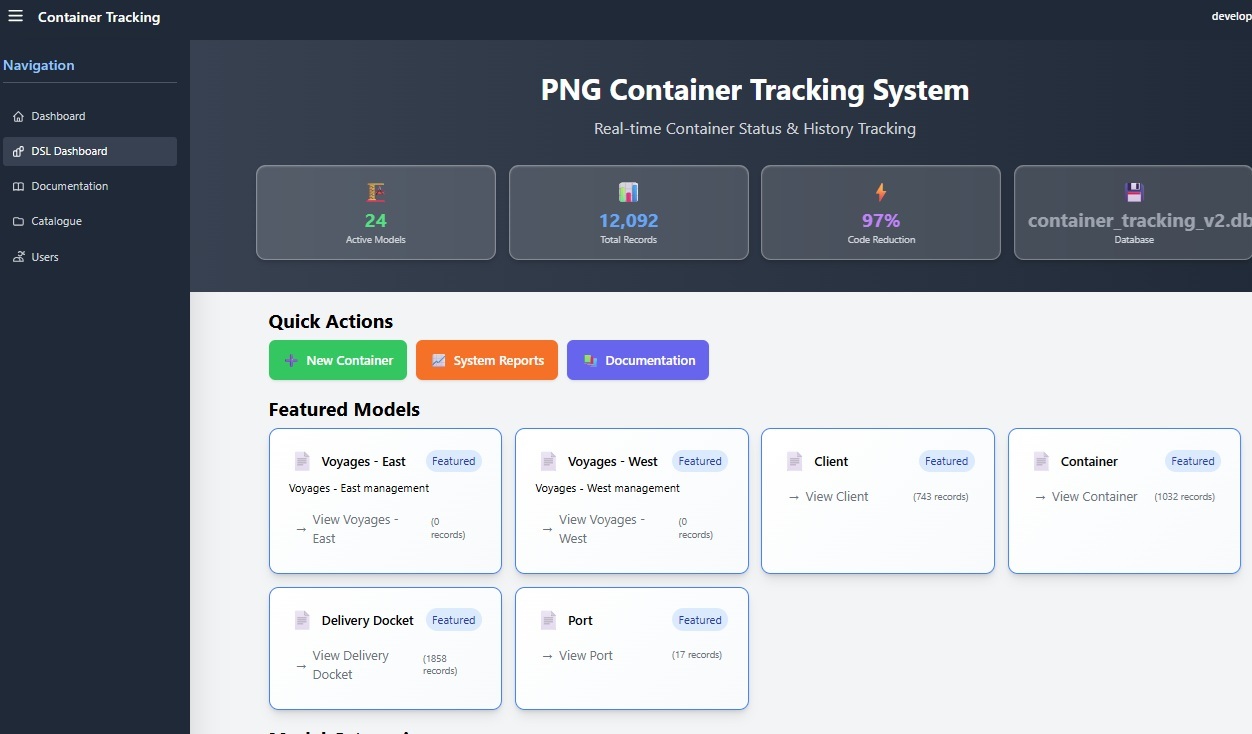
Container Tracking Study

Summary
This system formalises what South Sea Lines has been doing operationally in spreadsheets — with the same operational terminology — but with improved robustness, consistency, and resilience.
It began following a request from Neville Selwyn (aware of work we’ve been doing in this area) and was completed on a pro bono basis.
A secondary motivation was to validate newly developed, in-house tooling against real operational complexity; it met expectations.
Information (clients, ports/locations, container owners, business types, vessels, voyages, port calls and locations) was extracted from container movements, recorded in spreadsheets, and placed in sqlite databases. Normal deduplication and clean-up processes were omitted from the exercise.
Greg Sier - gregsier@gregsier.com.au - 61 418 785 786
Derived component features
-
Container registry — consistent container identity and ownership → Containers
-
Container history (movements as events) — explicit movement timeline; current status/location derived from latest event → Container History
-
Manifest context layered on container history — voyage/manifest views built from movement history → Manifesting
-
General DB application features — features and functions available for tables and models → Generic features
Scope boundaries
In scope: containers, container movements/history, manifest context, indicative demurrage exposure.
Out of scope: billing/invoicing, accounting integration, detailed analytics, ERP integration.
System at a glance
flowchart LR
  A[Operational spreadsheets] --> B[Ingestion and normalisation]
  B --> C[Reference data]
  B --> D[Container registry]
  B --> E[Container movement events]
  E --> F[Derived current status]
  E --> G[Manifest context]
Dashboards